


|
 |
|
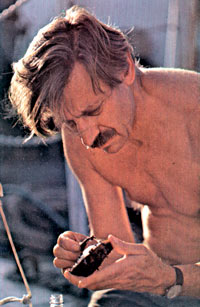
WHOI
microbiologist Holger Jannasch searches for vent bacteria on a mussel
shell on the 1979 cruise. (Photo by Emory Kristof © National
Geographic Society.)
|
|
 |
|
 |
|
|
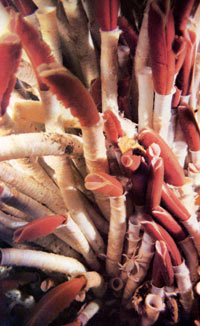
‘Stands of snow-white tubeworms crowned with feather-like blood-red plumes.’ (Photo by Emory Kristof © National Geographic Society.) |
A major discovery of the 20th century
Woods Hole biologist Holger Jannasch was aboard the 1979 Galápagos expedition and summed it up this way in an article in the Annual Review of Microbiology*:
“In the spring of 1979—after geologists had discovered dense populations of strange new animals clustered around hydrothermal vents in an area north of the Galápagos Islands—a group of biologists took Alvin back to the same site.
“It was an overwhelming experience to ‘fly,’ 2,550 meters deep, over dense beds of large mussels or even larger (up to 30 centimeters long) white clams, or stands of hundreds of snow-white tubeworms (up to two meters long) crowned with feather-like blood-red plumes.
“We were struck by the thought, and its fundamental implications, that here solar energy, which is so prevalent in running life on our planet, appears to be largely replaced by terrestrial energy —chemolithoautotrophic bacteria taking over the role of green plants. This was a powerful new concept and, in my mind, one of the major biological discoveries of the 20th century.”
* Vol. 51 © 1997 by Annual Reviews.
 Page 3 Page 3 |
The
Smoking Gun 
|