


|
 |
|
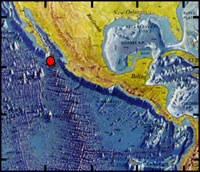
Weeks after the 1979 Galápagos dives, Alvin headed north to explore the East Pacific Rise at 21°N, where the first black smokers were discovered. (Physiographic map by Bruce C. Heezen and Marie Tharp) |
21°N
Fresh from its epic dives to examine the new-found communities of life around the Galápagos Rift vents, Alvin headed north aboard R/V/ Lulu in April 1979. They joined a U.S.-French expedition that was exploring another section of the mid-ocean ridge called the East Pacific Rise. The site was 1,800 miles north of the Galápagos Rift, just beyond the mouth of the Gulf of California at latitude 21°N. The U.S. group was led by Scripps scientists Fred Spiess and Ken Macdonald on board R/V Melville.
The year before, the French had done scouting work in the area. The submersible Cyana, a veteran of Project FAMOUS, dove into the valley of the rift. Scientists on board Cyana did not see any hydrothermal vents, but they did collect many rock samples. One rock looked like a long tube and had glistening crystals. But the unusual specimen was among hundreds that were collected. So it was not closely analyzed until months later.
The analysis showed that the rock was made of sphalerite (zinc sulfide). The specimen was full of metals—mostly zinc, but also iron and copper, and traces of lead and silver. That was intriguing, because to make a mineral such as sphalerite, you need extremely hot water—much hotter than the 23°C. (73°F) fluids measured at the Galápagos Rift.
 Oases of Exotic Life Oases of Exotic Life |
Page
2 
|