


|
 |
|
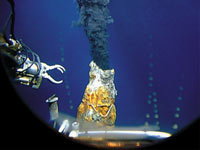
Black-smoker chimneys form when superheated fluids hit near-freezing seawater. Minerals in the fluids precipitate to form tubes that can grow very tall. (Photo by Patrick Hickey, WHOI) |
Smoke and minerals
When Alvin surfaced on April 21, 1979, Alvin engineer Jim Akens went to see what went wrong with the temperature probe that he had built. To his surprise, he found that the probe’s plastic tip had melted. That type of plastic melted at temperatures of 180°C (356° F)!
Alvin’s viewports were made of the same plastic. The viewports had been only a few feet away from the same hot fluids that melted the temperature probe!
Akens made a new probe that could measure higher temperatures. Scientists in Alvin used it to measure black-smoker hydrothermal vent fluids that reached 350°C (662°F). This was the temperature that MIT geochemist Edmonds had said was possible after he analyzed the lower-temperature hydrothermal fluids from the 1977 cruise. But most people could not easily believe it.
Temperatures of 350°C are hot enough to cause chemical reactions that extract metals from ocean crust rocks and dissolve the metals into hydrothermal fluids. When the superheated fluids hit cold, oxygen-rich seawater, the metals dissolved in the fluids come out of solution (or “precipitate”). Fluids erupting out of the vents become filled with dark metal particles—creating the illusion of “smoke.”
Precipitating minerals form “blacker-smoker” chimneys that can grow very tall. The tallest one found so far was a structure on the Juan de Fuca Ridge, which scientists called “Godzilla.” It reached 16 stories high before it toppled over.
The year of 1979 was a turning point for hydrothermal vent discovery and research. At Galápagos, hydrothermal vents were shown to be a warm womb that nourished an amazing diversity of life in the dark depths. At 21°N, scientists discovered black smoker chimneys spewing scalding hot fluids for the first time. They saw that hydrothermal vents were also great furnaces, where many of Earth’s great ore deposits were made.
 Page 2 Page 2 |