


|
 |
|
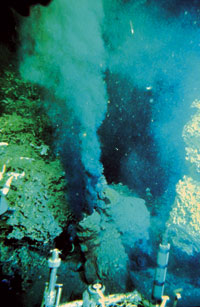
The first black-smoker chimney ever seen by humans— photographed at 21°N in 1979. (Photo by Dudley Foster, WHOI) |
|
 |
|
 |
|
|
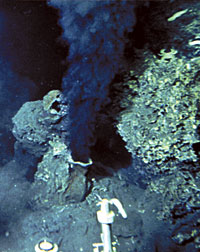
The chimney “smoke” really consists of superheated (350°C or 662°F) fluids that are filled with dark mineral particles. (Photo by Dudley Foster, WHOI) |
Superheated water at freezing depths
On April 21, 1979, Alvin dove in search of hydrothermal vents. Bill Normark of the U.S. Geological Survey and Thierry Juteau, a French volcanologistst, were the scientific observers. The pilot was Dudley Foster. He followed a trail of white clams on the seafloor. By now, everyone knew they would likely lead to vents.
Suddenly, the scientists came upon something no human had ever seen before. A tall spire of rock, about six feet tall, was sticking out of the seafloor. A jet of black fluid spewed out of the top—like smoke out of a chimney. Foster said it looked like smoke belching out of the smokestack of a steaming locomotive.
Foster approached to take a closer look. Hot, black fluids rushed powerfully upward from the chimney-like rock. It created an updraft that made it harder to steer Alvin. Foster knocked into the chimney. It crumbled, making a wider hole that let out a billowing cloud of black “smoke.” It became harder to see.
Using Alvin’s manipulator arm, Foster grabbed a probe to measure the temperature of the fluids. The reading inside Alvin’s sphere zoomed as high as it could go—to 32.7°C (91°F). The scientists thought it was a mistake and tried again. Again, the temperature reading shot up to the limit.
By now, Foster wanted to get out of the black cloud and moved on to another vent. He didn’t even bother to take a temperature reading because he assumed the probe wasn’t working properly.
 Page 1 Page 1 |
Page
3 
|