


|
 |
|
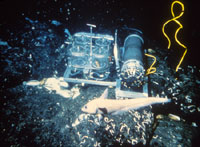
Biologists on the 1979 Galápagos cruise use a respirometer to measure the amount of oxygen mussels take up from seawater. (Photo by Ken Smith, SIO) |
|
 |
|
 |
|
|
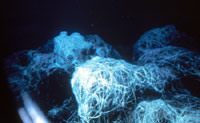
Spaghetti worms drape volcanic rocks on the seafloor near the vents. (Photo by James Childress, UCSB) |
Life without light
This rich abundance of animals depended on the warm fluids flowing out of the seafloor.
To live and grow on land, animals use carbon from plants or animals that they eat, and oxygen from the air. At the seafloor, vent animals get their oxygen from seawater. In fact, scientists discovered that the giant clams and tubeworms were such a rich red color because their blood contained hemoglobin—the same molecule that transports oxygen in human blood and makes it red.
So what do the vent animals eat to get the carbon they need to grow? They either eat other vents animals, as the crabs do, or they eat the smaller “life” at the base of the vent food chain—microorganisms.
The 1979 Galápagos expedition collected a huge variety of bacteria in the vent waters. Woods Hole biologist Holger Jannasch proved that these bacteria used hydrogen sulfide from vent fluids to take the carbon from carbon dioxide, a gas dissolved in seawater. They convert this carbon into “organic” carbon, which they can use as food.
Plants do the same thing, using carbon dioxide from air and sunlight as energy, in a process called photosynthesis. In the sunless depths, microorganisms create organic carbon using chemicals for their energy source, a process called chemosynthesis.
The sulfide-rich fluids streaming from the vents nourish an abundant supply of microorganisms, which feed an abundance of animals. Who could have imagined that the dark, cold seafloor would be one of the most fertile places on Earth?
 Page 2 Page 2 |
Page
4 
|