


|
 |
|
|
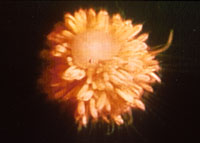
The curious creature first called a “dandelion” by geologists during the 1977 cruise turned out to be a siphonophore, a cousin of the Portuguese man-of-war (Photo by Al Giddings © National Geographic Society) |
||
 |
||
|
||
|
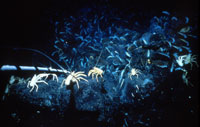
Alvin’s meter-long temperature probe extends toward a community of galatheid crabs perched atop pillow lava and a dense field of mussels. (Photo by Robert Hessler.) |
||
|
||
|
||
|
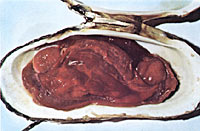
The flesh inside the giant clams is blood red because it contains hemoglobin—the same substance that transports oxygen inside human blood. (Photo by Emory Kristof © National Geographic Society.) |
||
|

A parade of strange creatures
“Nothing could diminish the excitement of seeing the animals for the first time,” Grassle wrote in Oceanus. And nothing could prepare them for what they found.
On each of its dives, Alvin’s front basket and cameras captured a remarkable variety of animals that never had been seen before: unknown mussels, anemones, whelks, limpets, featherduster worms, snails, lobsters, brittle stars, and blind white crabs. One crustacean seemed to have teeth on the end of eyestalks, which scientists speculated were used to scrape food off rocks. A new species of giant white clams with blood-red flesh was given the scientific name magnifica. The delicate, orange, dandelion-looking creature seen on the 1977 cruise turned out to be called a siphonophore—a cousin of the Portuguese man-of-war. Alvin technicians fashioned a special “dandelion-catching” container, but the siphonophore quickly disintegrated after it was brought to the surface.
At a newly found vent site called “Rose Garden,” scientists found red-tipped tubeworms that were an astonishing 8-feet tall. Aboard ship, they found that the tubeworms had no mouth to take in food and no guts to digest food!
“Literally every organism that came up was something that was unknown to science up until that time,” said Richard Lutz, then a post-doctoral scientist at Yale, now a professor at Rutgers University. “ It made it terribly exciting. Anything that came (up) on that basket was a new discovery.”
 Page 1 Page 1 |
Page 3 
|