


|
 |
|
|
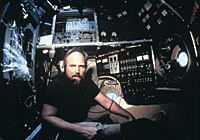
Biologist Fred Grassle dives to the Galápagos Rift vents in 1979 in Alvin. (Photo by Al Giddings © National Geographic Society) |
||
 |
||
 |
||
|
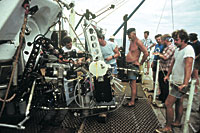
WHOI’s submersible Alvin was extensively modified to accommodate new equipment for the biological dives to the vents. (Photo by Fred Grassle, WHOI) |
||
|
||
 |
||
|
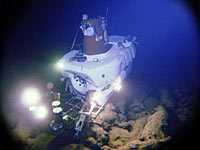
Alvin explores the Galápagos Rift vent sites in 1979. (Photo by Emory Kristof © National Geographic Society.) |
||
|
||
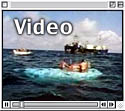
A film crew from the National Geographic Society participated in the Spring 1979 cruise and produced a documentary. Click on the video icon for excerpts from that film. |
Biologists get their first look at the vents
Scientists had hoped to find hydrothermal vents on the 1977 Galápagos Rift expedition. No one had expected to find lush communities of vent life, so there were no deep-sea biologists on the 1977 cruise. Biologists were bursting with eagerness to investigate these extraordinary deep-sea oases for themselves. But it took nearly two years to mount a return expedition.
In 1979, the National Science Foundation sponsored Galápagos expeditions using Woods Hole’s R/V Lulu and Alvin, and R/V Gillis, operated by the University of Miami. The chief scientist was J. Frederick Grassle, then a scientist at Woods Hole Oceanographic Institution, now director of the Institute of Marine and Coastal Sciences at Rutgers University. Grassle organized a team of biologists from many institutions. Their goal was to examine how animals thrive in an environment that seemed so harsh.
For this historic cruise, the scientists built special instruments to collect samples of microorganisms and larger animals at the vents. They made experimental devices to learn how the animals were eating and breathing.
To hold the new equipment, a new basket was installed in the front of Alvin. It also got a second manipulator (it had only one left arm before) to help carry out all the sampling the biologists hoped to do. A new, one-of-a-kind, deep-sea movie camera and special underwater lights were installed for filming by the National Geographic Society. National Geographic created an award-winning documentary called Dive to the Edge of Creation.
“We would subject the newly discovered communities to the full arsenal of techniques available to modern biology,” Grassle wrote in a 1998 article in Oceanus.
 Astounding Undersea Discoveries Astounding Undersea Discoveries |
Page
2 
|