


|
 |
|
|
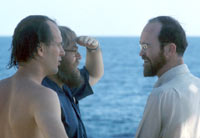
Scientists of the 1977 Galápagos Rift Expedition (left to right), Bob Ballard, Jack Corliss, and John Edmond, convene on the deck of R/V Knorr. (Photo by Ken Peal, WHOI) |
||
|

‘It was like Columbus’
“A whole lot of things sort of fell into place,” said John Edmond, a geochemist from MIT, in Victoria Kaharl’s book Water Baby. “About halfway into the cruise, we realized that regular seawater was mixing with something. It was a unique solution I had never seen before.
“We all started jumping up and down. We were dancing off the walls. It was chaos. It was so completely new and unexpected that everyone was fighting to dive (in Alvin). There was so much to learn. It was a discovery cruise. It was like Columbus.”
In the years since vents were discovered at Galápagos, scientists have determined that sulfate, which is abundant in seawater, is converted into hydrogen sulfide as the seawater circulates in the ocean crust. Bacteria and other microorganisms use the hydrogen sulfide in the hydrothermal fluids to live and grow. Higher organisms feed on these bacteria.
This deep-sea food chain, which was unknown before 1977, does not require the energy or processes on which most life on Earth depended: sunlight and photosynthesis.
 Page 7 Page 7 |
Page 9 
|