


|
 |
|
|
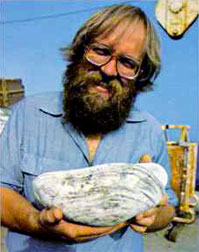
John B. Corliss cradles a specimen of a giant clam retrieved on 1977 Galápagos
Rift expedition. (Photo by Emory Kristof © National Geographic Society.) |
||
| ||
| ||
|

A foul-smelling clue
The scientists on board R/V Knorr were astonished by the discovery of life thriving without sunlight on the seafloor. They were eager to figure out what the organisms were eating.
“But we were not biologists. We were supposed to be finding warm water.” Ballard wrote in his book The Eternal Darkness.
The scientists never imagined finding so much life on the seafloor, so they had no reason to stock the ship with lots of chemicals to preserve biological specimens. They stored specimens of clams and other seafloor animals retrieved by Alvin in a small amount of formaldehyde that one student had brought. Then they used the closest thing to formaldehyde that they had on board—some strong Russian vodka bought in Panama. But there was not nearly enough to preserve all the specimens.
What were these newly discovered organisms feeding on? Water samples from the vents obtained by Alvin soon provided a powerful clue. As chemists drew the first water sample, the smell of rotten eggs filled the lab. Crew members and scientists rushed to open portholes. The water was full of hydrogen sulfide.
 Page 6 Page 6 |
Page 8 
|