


|
 |
|
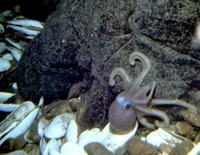
| A purple octopus scavenges in a clam-filled vent site (Photo by Robert D. Ballard, WHOI) | ||
 |
||
 |
||
|
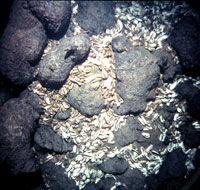
ANGUS took this photo of dead clams at Clambake 2. The clams died because the vent was no longer active. (Courtesy of WHOI Archives) |
||
|
||
 |
||
|
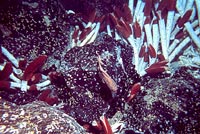
Tubeworms, white crabs, and a pink fish gather at a Galápagos Rift vent site (Photo by John M. Edmond, MIT) |
||
| ||
|

The ‘Garden of Eden’
The scientists called the area that Corliss, van Andel, and Donnelly found “Clambake 1.” But later dives in Alvin discovered four other vent sites with other thriving communities of life. The scientists gave playful names to each one.
Aside from the big white clams, “Clambake 1” had brown mussels, many white crabs, and a purple octopus, which probably preyed on other animals at the vent.
Soon the scientists found “Clambake 2,” where all the clams were dead. This was thought to be the site found the year before by the Pleiades expedition.
The “Dandelion Patch” had small, never-seen-before, orange animals that resembled—you guessed it—dandelions. The “Oyster Bed” vent site had no oysters (but, remember, geologists—not biologists—were doing the naming!).
Finally, the scientists came upon a vent site filled with tall, 1 1/2-foot-high, white-stalked tubeworms with bright red tops. Swaying in the water, they looked like a field of flowers swaying in the wind. Water temperatures here reached a balmy 17°C (63°F). The scientists called this site “The Garden of Eden.”
 Page 5 Page 5 |
Page 7 
|