


|
 |
|
|
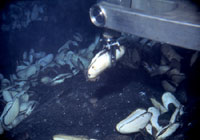
Alvin’s manipulator arm picks up a large clam from the Clambake 1 vent site. (Photo by Robert D. Ballard, WHOI) |
||
 | ||
 |
||
|
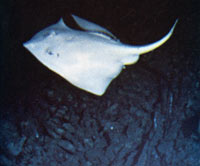
ANGUS captured this photo of a skate swimming above lava near the Galápagos Rift vent site. (Photo courtesy of WHOI Archives) |
||
| ||
| ||
| ||
| ||
|

Entering another world
Within hours of the startling clam discovery, R/V Lulu with Alvin on board arrived on the scene. The Alvin technical team prepared the submersible, and scientists eagerly awaited the dive at sunrise the next morning—Feb. 17. It was Alvin dive No. 713. Jack Donnelly was the pilot. Jack Corliss and Tjeerd van Andel were the scientific observers.
Guided by Sleepy, Dopey, and Bashful, Alvin used the acoustic beacons to zero in on the area where ANGUS had photographed the clams. “But when they reached their target coordinates,” Ballard wrote in Oceanus, “ Alvin and its three-man crew entered another world. Coming out of small cracks cutting across the lava terrain was warm, shimmering water that quickly turned cloudy blue as manganese and other chemicals in solution began to precipitate out of the warm water and were deposited on the lava surface, where they formed a brown stain.”
Alvin’s temperature sensors measured water temperatures of 8°C (46°F) at the bottom of the sea. The first hydrothermal vent had been discovered.
“But even more interesting was the presence of a dense biological community living in and around the hydrothermal vents,” Ballard wrote in Oceanus. White clams—up 30 centimeters (1 foot) long—clustered in an area about 50 meters (165 feet) across.
Observing the scene from Alvin’s viewports, Corliss talked by acoustic telephone to his graduate student Debra Stakes, who was aboard R/V Lulu.
“Isn’t the deep ocean supposed to be like a desert?” Corliss asked. When Stakes answered, “Yes,” Corliss replied: “Well, there’s all these animals down here.”
 Page 4 Page 4 |
Page 6 
|