


|
 |
|
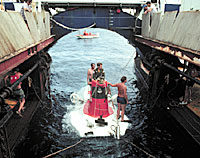
Divers prepare Alvin between the pontoons of its mother ship, Woods Hole’s R/V Lulu. (Courtesy of WHOI Archives) |
The discovery cruise begins
The Southtow and Pleiades expeditions had identified the Galápagos Rift as a prime locale to find hydrothermal vents. Project FAMOUS had proved the ability of submersibles to explore mid-ocean ridges. It was time to take Alvin to the Galapágos.
The Galápagos Hydrothermal Expedition, funded by the National Science Foundation, began on Feb. 8, 1977, with Woods Hole’s R/V Knorr cruising out of the Panama Canal. It was headed to a likely hydrothermal spot marked the year before by the Pleiades expedition. The target was about 640 kilometers (400 miles) west of Ecuador and 330 kilometers (250 miles) northeast of the Galápagos Islands. As it did for Project FAMOUS, the U.S. Navy had made detailed seafloor maps of the region using its powerful, top-secret SASS sonar system.
The expedition included Richard Von Herzen and Robert Ballard of Woods Hole, Jack Corliss, Jack Dymond, and Louis Gordon of Oregon State University, John Edmond and Tanya Atwater of the Massachusetts Institute of Technology, Tjeerd van Andel of Stanford, and Dave Williams of the U.S. Geological Survey.
It was a team of top-notch geologists, geochemists, and geophysicists hunting for hydrothermal vents. No one imagined any need for a biologist on board.
 Homing In Homing In |
Page 2 
|