


|
 |
|
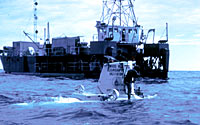
Alvin and its former mother ship, Woods Hole Oceanographic Institution’s R/V Lulu. (Courtesy of WHOI Archives) |
 |
 |
|
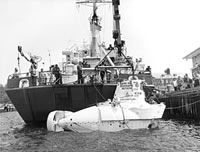
Alvin and R/V Knorr prepare to depart for Project FAMOUS. (Photo by Frank Medeiros) |
Down to the seafloor in submersibles
In June of 1974, the FAMOUS fleet met in the Azores. Archimède was towed by the French ship Marcel le Bihan. Cyana was on the deck of Le Noirot. Alvin (named after its early champion, WHOI scientist Allyn Vine) was aboard its mother ship R/V Lulu (named after Vine’s mother). Woods Hole’s R/V Knorr towed R/V Lulu.In position to drill a core of the seafloor was D/V Glomar Challenger, a converted oil drilling ship recently commissioned by the National Science Foundation for the Deep Sea Drilling Project.
For the first time in history, scientists descended to the bottom of the sea to explore a mid-ocean ridge. They descended between the steep, 5,000-foot ridge flanks into a rift valley as deep as the Grand Canyon. They saw for the first time the narrow zone where magma oozed through seafloor cracks, paving the seafloor and creating new crust—and by this process, spreading the North American and European tectonic plates apart.
Alvin made 17 dives and spent 81 hours on the seafloor. Archimède and Cyana completed 27 dives. Scientists used these submersibles to collect 100,000 photos and 3,000 pounds of rock samples, including evidence of manganese and iron deposits. They proved that submersibles could effectively explore the dark, tortuous, volcanic seafloor. They gave geologists the ability to investigate and map unknown terrain on the seafloor—much the way geologists always did on land.
The explorers discovered vast fields of seafloor lava, but they found no evidence of hydrothermal vents.
 Page 4 Page 4 |
Page
6 
|