


|
 |
|
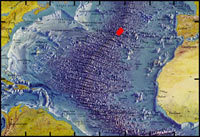
Project FAMOUS explored the Mid-Atlantic Ridge crest between 36°N and 37°N. (Physiographic map of the North Atlantic Ocean by Bruce C. Heezen and Marie Tharp) |
|
 |
|
 |
|
|
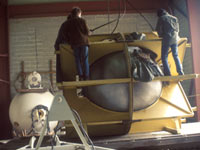
Alvin is refitted with its new titanium sphere to double its diving range to 12,000 feet. (Courtesy of WHOI Archives) |
|
|
|
 |
|
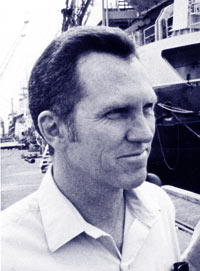
| WHOI’s James R. Heirtzler was the U.S. leader of Project FAMOUS. (Courtesy of Scripps Institution of Oceanography) |
A full-scale effort to lay the groundwork
“The preliminary work (for Project FAMOUS) resembled the kind of planning, detailed study, simulation, and training that goes on before a major space mission,” wrote Bob Ballard in his book The Eternal Darkness (Princeton University Press, 2000).
Alvin’s steel sphere, which enclosed its human occupants, was replaced with a titanium sphere in 1973. It could withstand twice as much pressure and extended Alvin’s diving range from 6,000 to 12,000 feet. Pilots and scientists received special diving training.
The target area for Project FAMOUS was about 9,000 feet deep on a section of the Mid-Atlantic Ridge, between 36°N and 37°N, nearly 400 miles southwest of the Azores Islands. Starting in 1972, “an aircraft carrying a magnetic sensor flew over this region of the ocean,” James R. Heirtzler of Woods Hole, the U.S. leader of Project FAMOUS, wrote in National Geographic magazine. “The sea floor was remapped by normal research ship echo-sounders. Then narrow-beam echo sounders on U.S. Navy and French hydrographic ships refined the bottom charts. Britain’s R.R.S. Discovery brought a seven-ton side-scan sonar system dubbed ‘Gloria’ and Scripps’ Institution of Oceanography provided a special Deep-Tow package.”
Scientists aboard ships conducting preliminary work for Project FAMOUS also used floating sonobuoys and instruments lowered to the seafloor to detect sound waves from earthquakes. Sound waves recorded by these devices revealed the hidden structure of rock layers in the ocean crust below the seafloor.
 Page 2 Page 2 |
Page
4 
|