


|
 |
|
Mike Legg, then a graduate student on the Southtow expedition, throws a sonobuoy overboard to detect micro-earthquakes at the seafloor. (Photo courtesy of Ken Macdonald, UCSB) |
|
 |
|
 |
|
|
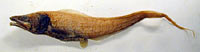
Scientists on Southtow analyzed dead bottom-dwelling fish that they found floating on the sea surface. This one is a cusk eel (Porogadus sp.) and is 41.5 cm (about 17 inches) long. The fish were found in an area where scientists had detected a swarm of seafloor micro-earthquakes (and where hydrothermal vents were discovered five years later). In retrospect, the scientists concluded that the quake activity indicated a seafloor eruption, and the fish were killed by a powerful force that ruptured their swim bladders. (Photo by Philip Hastings, Scripps Institution of Oceanography) |
Telltale heat and mini-quakes
Using Deep-Tow, Southtow scientists measured water temperatures just above the seafloor and found they were a few tenths of a degree higher than normal seawater. This was slight but important evidence of hydrothermal activity.
The measurements of the heat flowing in seafloor sediments showed a curious pattern—the heat flow was higher in some areas and cooler in others. To explain this, David Williams and Richard Von Herzen of Woods Hole Oceanographic Institution theorized that hot fluids were rising out of the high heat-flow areas and cold seawater was sinking down into the low heat-flow areas. This pattern of circulating hot and cold fluids is called hydrothermal circulation—from the Greek words hydros (water) and thermos (heat).
During Southtow, scientists also used instruments called sonobuoys. These devices were developed during World War II to listen for submarines, but they were sensitive enough to detect earthquakes beneath the seafloor.
Using sonobuoys, Ken Macdonald, then a Woods Hole graduate student and now a professor at the University of California, Santa Barbara, detected bursts of small seafloor earthquakes over several days—sometimes as many as 80 per hour. These micro-earthquakes seemed to be occurring in the same area where bottom-water temperatures were slightly higher.
Then Macdonald saw something he had never seen before—or since. Floating on the surface were lots of dead fish. They were a kind of fish that only lived at great depths near the seafloor.
Soon, all these clues would fall into place. The micro-quakes were creating seafloor cracks that set the stage for hydrothermal circulation. In the same location where Macdonald detected the micro-quakes, scientists five years later would discover a lush community of seafloor life that they would call the “Garden of Eden.”
 The Trail Gets Hot The Trail Gets Hot |
Project
FAMOUS 
|