Major
Discoveries
INTRO
| A CHANGED VIEW OF “LIFE” | NEW
UNDERSTANDING OF EARTH
 |
 |
A Changed View of “Life” Chemosynthetic bacteria— not photosynthetic plants— form the base of the food chain at hydrothermal vents. (Photo by Carl Wirsen, WHOI) Click to enlarge |
An entirely new way to sustain life
Printable version of this article
To understand how the discovery of hydrothermal vents dramatically changed scientists’ thinking about life, you have to understand what scientists had believed before vents were found.
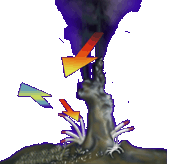 |
| Click HERE to learn more about photosynthesis and chemosynthesis. |
In the sunlit ocean surface, microscopic marine plants called phytoplankton flourish-like great fields of grasses on land. Marine animals eat the phytoplankton much the way insects or zebras eat plants on land. And predators eat other animals.
When all these marine plants and animals die, they sink to the bottom. This organic material rains down to feed bottom-dwelling (or “benthic”) animals. Occasionally, the carcass of a dead whale might sink down to provide a feast! Scientists had thought this was the only way life could survive on the deep seafloor.
The discovery of hydrothermal vents changed all that. Vast communities of animals grew big and fast in the depths! Instead of using light to create organic material to live and grow (photosynthesis), microorganisms at the bottom of the food chain at vents used chemicals such as hydrogen sulfide (chemosynthesis).
At the seafloor, thriving ecosystems receive energy from a source that had never been thought of before-heat and chemicals from the planet itself. The energy to sustain life was not coming down from the sun. It was coming up from the interior of the earth.
 Intro Intro |
Page 2  |