INTRO | A CHANGED VIEW OF “LIFE” | NEW UNDERSTANDING OF EARTH
 |
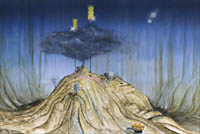 |
Hydrothermal venting sometimes creates massive mounds filled with iron-, zinc-, and copper-rich mineral deposits. (Illustration by E. Paul Oberlander, WHOI Graphics Services) |
Besides being great chemical reactors for our planet, hydrothermal systems on mid-ocean ridges are also great furnaces that produce many mineral deposits on Earth.
The basic process is the same one that produces seafloor black smoker chimneys. Beneath the seafloor, chemical reactions between hot hydrothermal fluids leach metals (such as iron, zinc, copper, lead, and cobalt) out of ocean crust rocks. These metals are concentrated in hydrothermal fluids and carried up to the seafloor. There, they encounter near-freezing seawater that is full of oxygen. This sparks new chemical reactions. The metals come out of solution, or precipitate, forming hydrothermal deposits that are enriched with metals.
Hydrothermal venting produced multi-colored, mineral-rich sediments in the Red Sea that first intrigued scientists in the mid-1960s, and the curious mineral-speckled Galápagos mounds discovered by the 1972 Southtow expedition.
Since then, scientists have found that seafloor mineral deposits come in many varieties. In 1984 and 1985, German scientists aboard the research vessel Sonne unexpectedly discovered a hydrothermal deposit near the Galápagos quite unlike anything seen before. The site had irregular white heaps and towers that measured 1 to 2 meters (3 to 6 feet) in height and 0.5 to 1 meter (1.5 to 3 feet) in diameter. They were made also entirely of white silica and resembled gigantic cauliflowers. The site was called “Cauliflower Garden.”
In 1980 and 1981, scientists found massive mineral deposits at a site near the Galápagos where hydrothermal venting has been occurring for a long time. Layers of rock that had once been under the seafloor were exposed, and scientists could see branching pathways of big and small cracks and faults—the “plumbing system” through which hydrothermal fluids flow to the surface.
In the mid-1980s, scientists discovered a massive mineral deposit on the Mid-Atlantic Ridge that they named the Trans-Atlantic Geotraverse (TAG) site. The iron- and copper-rich TAG site measures 150 meters (500 feet) in diameter and rises 50 meters (165 feet) high. It has an estimated 4 million tons of metal-rich rocks in it. The Ocean Drilling Project drilled 17 holes into the TAG mound to sample rocks deep inside the mound. They found that the mound was like a big layer cake-with different layers filled with different types of minerals.
The great copper mines of Cyprus were probably formed the same way that TAG was. We have discovered that some of the best mineral deposits on land are made at mid-ocean ridges by hydrothermal venting.
 Page 1 Page 1 |
Into the Future  |