INTRODUCTION | LIFE IN EXTREME ENVIRONMENTS | EXTRATERRESTRIAL LIFE? | VENTS AROUND THE WORLD | DEEP-SEA OBSERVATORIES
 |
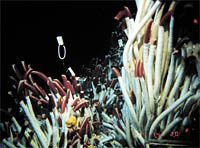 |
Scientists have placed blank blocks of rock (marked by a floating piece of foam) near vent sites to test how larvae of vent animals settle at the sites and grow. (Photo by Lauren Mullineaux, WHOI) |
How vent animals are distributed around the world’s oceans also remains a mystery.
Vent animals flourish when the hydrothermal vents are active, but they are doomed if the vents shut down. The animals’ only hope of avoiding extinction is to send out tiny larvae to find and colonize other active vent sites. But vent sites are often isolated oases amid a cold ocean desert.
How do these larvae travel through the oceans? Are they carried away by buoyant plumes of hydrothermal vent fluids, or by deep current currents? Do the large, deep faults that break the global mid-ocean ridge into segments create barriers to larval migration? How do they avoid getting eaten? Do traces of toxic metal particles in hydrothermal plumes deter predators? How do the larvae find new vents? Are there chemical clues that allow them to home into a new home? How do they survive potentially long journeys before they find a suitable vent?
In 2001, a team of scientists, which included Lauren Mullineaux of Woods Hole, Craig Young of Harbor Branch Oceanographic Institution, and Adam Marsh and Donal Manahan of the University of Southern California, found an answer to the last question. They showed that tubeworm larvae could survive for 38 days—potentially long enough to locate another active vent before they run out of food.
Scientists are still pursuing answers to the other fascinating questions.
 Page 3 Page 3 |
Deep-Sea Observatories  |