INTRODUCTION | LIFE IN EXTREME ENVIRONMENTS | EXTRATERRESTRIAL LIFE? | VENTS AROUND THE WORLD | DEEP-SEA OBSERVATORIES
 |
 |
What’s
in a name?
Printable
version of this page
Since
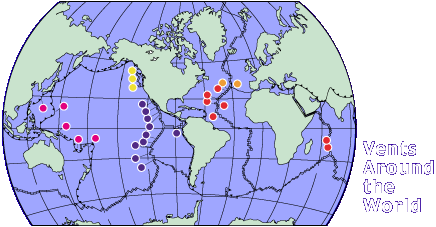
1977, scientists have discovered some 40 vent sites around the globe.
Many have interesting names. A site near the “Garden of Eden”
on the Galápagos Rift was named “East of Eden” (which
is also a novel by John Steinbeck). In the Atlantic, the seafloor topography
near the “Broken Spur” site has a series of “spurs”
coming off the ridge. The “Lucky Strike” vent site was found
by chance when scientists were dredging up samples of seafloor rocks.
“Snake Pit” was named after the slithering mass of white, eel-like
fish that scientists found living there.
In 2000, Japanese scientists discovered the first vent site in the Indian
Ocean and named it after their research vessel “Kairei.” Several
months later, a U.S. expedition found another Indian Ocean vent site and
named it “Edmond,” in memory of John Edmond, a renowned chemist
from MIT who had recently died. Edmond participated in the original 1977
Galápagos cruise and was a pioneer and leader of hydrothermal vent
research.
So far, most vents have been found on volcanically active mid-ocean ridges
with newly made seafloor crust. But that may be only because scientists
have focused their search for vents on ridges. In December of 2000, on
an expedition led by Donna Blackman of Scripps Institution of Oceanography
and Jeff Karson of Duke University, scientists in Alvin were surprised
to find a vent field in the Atlantic Ocean that was tens of miles away
from a ridge, on million-year-old seafloor crust. It had skyscraper-like
structures, many stories high that were made of white carbonate material,
not dark sulfide minerals. They called this unique vent site “Lost
City.”
 Extraterrestrial Life Extraterrestrial Life |
Page
2  |