INTRODUCTION | LIFE IN EXTREME ENVIRONMENTS | EXTRATERRESTRIAL LIFE? | VENTS AROUND THE WORLD | DEEP-SEA OBSERVATORIES

|
 |
The proposed NEPTUNE system off the northwest U.S. coast would link a network of seafloor observatories via fiber-optic cables—to each other and to shore. (Illustration by Hunter Hadaway and Mark Stoermer, U. of Washington Center for Environmental Visualization) |
In recent years, dramatic advances in deep submergence vehicles and technologies have allowed scientists to survey and sample vent sites and make more-detailed maps of vent sites. Autonomous underwater vehicles (AUVs) are being developed and tested. These unoccupied vehicles will have the capacity to stay submerged for long periods. They will be dispatched into remote regions that scientists haven’t been able to reach yet, including ice-covered polar oceans.
Scientists and engineers are also developing new oceanographic instruments and robotic systems that can remain in the oceans for long periods of time—including deep-sea cameras, chemical and temperature sensors, and devices to measure small earthquakes and changes in the shape of the seafloor.
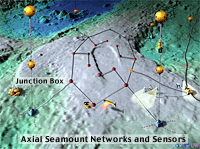
Their goal is to create long-term, deep-sea observatories arrayed with instruments that can continuously monitor events and processes occurring on the seafloor. One already existing example is the New Millennium Observatory (NeMO), established by NOAA’s Pacific Marine Environmental Laboratory (www.pmel.noaa.gov/vents/nemo/index.html). It is located at an active seafloor volcano called “Axial Seamount” on the Juan de Fuca Ridge, about 250 miles off the coast of Oregon and Washington.
In a new era of oceanographic exploration, scientists envision many long-term, deep-sea observatories. Some may use novel communications technology to transmit data to the surface and then via satellite to shore. NEPTUNE (North East Pacific Time-Series Undersea Networked Experiments) is a plan to establish a network of seafloor observatories throughout the Juan de Fuca Plate—all linked to each other and to shore via submarine fiber-optic cables (http://www.neptune.washington.edu/).
Deep-sea observatories will provide the capability for scientists in their labs to monitor deep-sea vents and control experiments and equipment on the seafloor thousands of kilometers away, and thousands of meters beneath the ocean surface.
Nearly 99 percent of the ocean floor is still unexplored. It remains a frontier. What extraordinary discoveries will the next 25 years bring?
 Page 1 Page 1 |