INTRODUCTION | LIFE IN EXTREME ENVIRONMENTS | EXTRATERRESTRIAL LIFE? | VENTS AROUND THE WORLD | DEEP-SEA OBSERVATORIES

 |
|
Deep-Sea
Observatories |
Printable version of this article
Since deep-sea hydrothermal vents were first discovered 25 years ago, scientists have learned a great deal. Marine biologists, chemists, and geologists have continued to sample and study vent sites around the globe to understand how mineral deposits form, and how life is sustained in extreme environments, and how vent animals find and colonize deep-ocean sites.
But hydrothermal vents and vent life are the result of many interacting processes. At vents, geology, chemistry, physics, and biology all combine. It's difficult to see which factors cause what effects—especially when scientists must wait years before they can revisit a vent site.
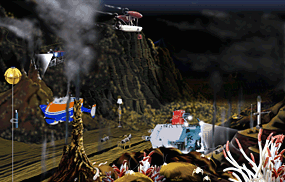
Because the oceans are vast, the deep seafloor is hard to reach, and ships and submersibles are limited, scientists have gotten only a few snapshots of vents for a few hours a day in Alvin during expeditions. What scientists need is the ability to monitor sites continuously over long periods of time—to see how and why vents and vent communities change and evolve, over timescales ranging from seconds to decades.
They need to see not only what’s down there, but what’s going on down there.
 Vents Around the World Vents Around the World |
Page 2  |