INTRODUCTION | LIFE IN EXTREME ENVIRONMENTS | EXTRATERRESTRIAL LIFE? | VENTS AROUND THE WORLD | DEEP-SEA OBSERVATORIES
 |
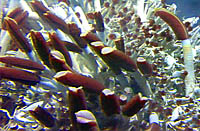 |
Tubeworms were living at the seafloor when dinosaurs walked the earth. (Photo by William Lange, WHOI) |
Earth was constantly bombarded by meteorites in its first several billion years. But the effects of meteorites probably did not penetrate into the deep sea. During those early times, the seafloor may have been the safest place for living things. And hydrothermal vents may have had all the necessary ingredients to spark chemical reactions that could create the building blocks of life. Some scientists have raised the idea that life may have begun at ancient seafloor hydrothermal vents.
Difficult conditions test the ability of organisms to survive. Species that could not adapt died out. Species with the best adaptations survived and passed on beneficial adaptations to their offspring over millions of years. Conditions were much harsher when Earth was a young planet. So by studying life in extreme environments, scientists can piece together how life may have evolved on Earth.
About the same time that Rachel Haymon of the University of California at Santa Barbara and her colleagues saw “snow blowers” at the seafloor in 1991, she also found fossil tubeworms in an ophiolite in Oman. The fossils were 95 million years old, so tubeworms were probably using hemoglobin to transport oxygen long before humans ever existed.
It is also interesting to know that tubeworms were living at the same time that dinosaurs walked on land. A colossal asteroid killed off the dinosaurs about 65 million years ago, but tubeworms on the seafloor survived.
 Page 2 Page 2 |
Extraterrestrial Life?  |