INTRODUCTION | LIFE IN EXTREME ENVIRONMENTS | EXTRATERRESTRIAL LIFE? | VENTS AROUND THE WORLD | DEEP-SEA OBSERVATORIES
 |
 |
|
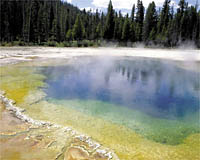
A heat-resistant enzyme in microbes living in a hot spring in Yellowstone National Park was a key factor in launching a revolution in biotechnology. (Stock photo) |
Many species have adapted to extreme conditions in ingenious ways—like the Pompeii worms that survive the high temperatures on the side of black smoker chimneys, or tubeworms that maintain bacteria farms inside of them. Scientists have found many examples of deep-sea, single-celled microbes that have unusual features or make use of unusual chemical processes. They are well adapted to carve out a niche where they can thrive, but other species cannot.
Some of these adaptations have proved useful to people. Only a few years ago, scientists found a previously unknown microbe living in a hot spring in Yellowstone National Park. The microbe had a heat-resistant enzyme. That enzyme was the key to a chemical reaction that has given scientists new-found ability to reproduce large amounts of DNA. It launched a revolution in biotechnology.
Heat-resistant enzymes from microbes found at seafloor vents have been used similarly for useful purposes. And there are many other examples of adaptations in “extreme” microbes that are important to our society and economy.
For example, the mining industry uses huge vats filled with microbes that naturally dissolve rocks into acid. The microbes actually do the work of extracting valuable minerals out of ores. The food industry adds bacteria that secrete a certain binding substance to ice cream to help maintain its texture. Oil-eating bacteria are used to clean up oil spills. What other organisms will we find in extreme environments with unusual features that will lead to useful products or life-saving drugs? The ocean floor holds enormous potential for discoveries that could improve our lives.
 Page 1 Page 1 |
Page 3  |