INTRODUCTION | LIFE IN EXTREME ENVIRONMENTS | EXTRATERRESTRIAL LIFE? | VENTS AROUND THE WORLD | DEEP-SEA OBSERVATORIES

 |
|
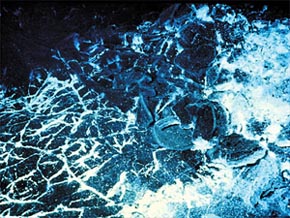
Life in Extreme Environments Thick layers of bacteria cover seafloor lava shortly after a volcanic eruption on the East Pacific Rise at 9°50’N in 1991. (Photo courtesy of WHOI Deep Submergence Group) Click to enlarge |
Printable version of this article
The amazing discovery of life flourishing at hydrothermal vents ushered in new ideas of where and how life could exist. Scientists have now found species of microorganisms that have adapted to high pressure, unusual or toxic chemicals and minerals, low supplies of nutrients, and high (113°C or 235°F) temperatures. They are called extremophiles (“extreme lovers.”) Under a wide range of conditions, life seems to find ways to survive.
The 1991 discovery of “snow blower” vents blasting white bacterial matter into the ocean opened up another previously unimagined possibility. Scientists are now exploring whether potentially huge communities of microorganisms are living in reserviors in the cracks and crannies below the seafloor! This so-called “deep biosphere” may be as large as the biosphere on Earth’s surface.
When submarine volcanic eruptions occur on mid-ocean ridges, subsurface waters heat up and microorganisms beneath the seafloor go crazy. They reproduce at extremely high rates. Huge volumes are carried out through openings in the seafloor and dispersed into bottom waters.
The bacteria also produce the white mats of “snow blower” debris that cover the seafloor, as snow covers a mountain. WHOI biologists Craig Taylor and Carl Wirsen showed how these bacteria use the hydrogen sulfide in vent fluids to make solid, white, sulfur filaments. Large populations of these bacteria link these filaments together to produce mats, which help keep the bacteria attached to rocky surfaces. In this way, they stay bathed in life-sustaining (for them at least!) hydrothermal fluids percolating from the ocean crust. (The bacterial mats may also form a layer of carpeting around vents that encourages animal such as Pompeii tubeworms to settle down and grow.)
 Introduction Introduction |
Page
2  |