INTRODUCTION | LIFE IN EXTREME ENVIRONMENTS | EXTRATERRESTRIAL LIFE? | VENTS AROUND THE WORLD | DEEP-SEA OBSERVATORIES

 |
|
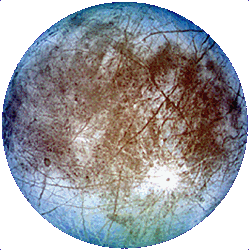
Extraterrestrial Life? Europa, a moon of Jupiter, is volcanically active and may have an ocean below its ice-covered surface. Does Europa have hydrothermal vents—and life? (Photo by NASA Voyager) |
Printable version of this article
Hydrothermal vents taught us that life could exist without sunlight or oxygen, in extreme conditions, by using unusual chemicals as an energy source. That jolted scientists into taking another look at the possibility of life on planets that previously seemed too hostile to support life.
In this new field called astrobiology, one of the most intriguing planetary bodies is Europa, a moon of Jupiter. Scientists believe Europa is volcanically active and may have an ocean below its ice-covered surface. The same ingredients—volcanic heat and water—form hydrothermal vents on Earth. Are there hydrothermal vents on Europa? Do they support life?
Mars was once volcanically active, and there is evidence that it once had abundant water. Did life develop on Mars? Do microbes still live deep beneath its dry, barren surface today? Can microbes be transported between planets—via meteorites, for example?
By studying microbes in hydrothermal systems on Earth, scientists are learning how life may develop and survive in extreme environments on other planetary bodies. The vehicles, tools, sensors, and techniques that scientists are developing to study life within and beneath Earth’s volcanic seafloor crust will be similar to those that scientists will use to explore remote environments and search for life elsewhere in the universe.
 Life in Extreme Environments Life in Extreme Environments |
Vents Around the World  |