DEEP SUBMERGENCE VEHICLES | SHIPS | SEANET | SONAR | NAVIGATION
Satellite Navigation
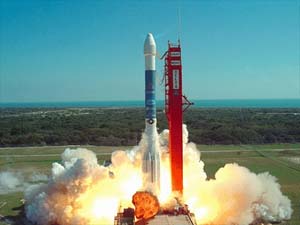
A GPS satellite being launched on a Delta II Booster rocket. More than 60 GPS satellites have been launched over the past 30 years. Photo by U.S. Coast Guard Navigation Center.
 |
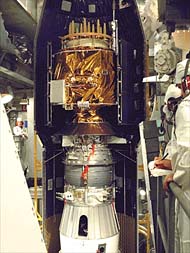 |
| A GPS satellite loaded into the nosecose of the delivery rocket. The folded-up gold foil is designed to spread out into the solar panels which provide power to run the satellite when it is orbiting in space. Photo by U.S. Coast Guard Navigation Center. |
The GPS was developed by the US Department of Defense primarily for military applications during the Cold War, but for about the last 25 years oceanographers have also been able to use satellite-based navigation to determine their position. Knowing precisely where you are is important because all of the data and observations you are collecting have to be referenced to a position on the Earth’s surface, or in our case, on the seafloor. In addition, we often want to return to a scientifically interesting seafloor site, which would be almost impossible to relocate without satellite navigation.
Normally four or more satellites are used to “fix” a ship’s position. The satellites and the receivers on the ship all have very precise, synchronized clocks. Satellites send radio waves to the ship and the clocks measure how long it takes for the signals to travel from the satellites to the ship. The longer it takes, the longer the distance between satellite and ship. In this way, time is converted to distance. Using measurements from at least three satellites (a method called triangulation), computers can calculate the unique point on the face of the Earth where all three (or more) distances measured from all the satellites intersect. That is where the ship is!
The current group, or constellation of GPS satellites now numbers 24. They are located in six circular orbits 20,200 kilometers (10,900 nautical miles) above the Earth at an inclination angle of 55 degrees. The satellites are spaced in orbit so that at any time a minimum of 6 satellites will be in view to users anywhere in the world. The satellites continuously broadcast their position and time data to users throughout the world. The civil GPS system, similar to that used on pleasure boats, and now in cars, has an accuracy of less than 100 meters. The system that most US oceanographic ships use is called P-code GPS -a military-grade system with an accuracy to 10 meters. This is the same system that the US armed forces uses for its ships, planes and surface transport systems.
More information on the GPS system can be obtained at the following Web site: http://www.navcen.uscg.gov/gps/default.htm#Status