It's like being Galileo, Jacques Cousteau, and Captain Nemo (the captain
of Jules Verne’s submarine Nautilus in Twenty Thousand
Leagues Under the Sea) all wrapped up in one. You are an inventor,
explorer, and scientist. Let's go down together!
Getting In
 |
 |
|
| Click
to see an Alvin launch |
It
is time to leave!! You climb the stairs on the side of the A-frame
to the top of Alvin. You are excited but slightly nervous
at the thought of what you are about to do. You remove your shoes
and stow them in the bag at the top of the steps. You climb down
a narrow ladder through Alvin’s hatch, trying not to
step on the head and arms of the pilot who is finishing his final
checks of all the submersible’s systems. You sit down on the
floor of the pressure sphere, which is only two meters (six feet)
in diameter, then crouch to one side of the sphere so the other
scientist can get in.
The Alvin crew has already stowed your bag containing warm
clothes and a notebook in the side of the sphere where you will
be sitting. Even more important, the galley has packed a lunch for
everyone. It includes sandwiches, fruit, water, coffee, and maybe
a chocolate bar!. The pilot radios the Top Lab Control and the Atlantis
bridge to say: “Closing the hatch”. From this point
on, you are a self-contained little probe set to explore the seafloor.
Here We Go!
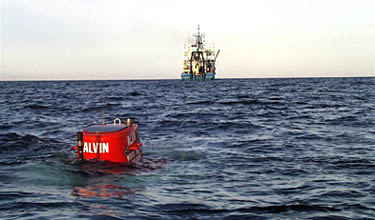
The A-frame lifts Alvin off the deck of the ship. Suddenly
you are over open water. The A-frame stops. You hear the main lift
line winch grumbling. Slowly you descend. Ten seconds later, you
splash down. Water gurgles over the view ports. You see the swimmers
working on the outside of the submarine, checking everything before
it dives. Inside, it is a little warm, but you've been told it will
get cooler as you descend. It is noisy due to the whirring of motors
and the scrubber. The scrubber is a blower that forces the air you
are breathing through a filter containing soda-lime. The soda-lime
absorbs carbon dioxide so that the air in Alvin is good to
breathe.
The submarine gently rolls in the calm water as the pilot picks
up the CB microphone. “Atlantis, this is Alvin.
ID light is on. All leaks, dumps, and grounds normal. Scrubber is
scrubbing. Oxygen is on. Request launch altitude and permission
to dive.” A few seconds later, the reply comes back. “Alvin,
this is Atlantis. Launch altitude 2005 meters. You have permission
to dive.” The pilot replies: “Roger, Atlantis.
Alvin diving.”
Into The Abyss
Ten minutes later, you notice that it is getting dark outside the
view port. At about 400 meters depth (1312 feet), so little sunlight
penetrates down that the water appears pitch black. You have just
passed below the photic zone and are now entering the deep dark
ocean. It’s getting cold, so you put on your sweatshirt, sweatpants
and wool socks while trying not to kick the other observer or the
pilot. The pilot tells you to look out the view port. You put your
nose up to the plastic. Suddenly you see a burst of light and what
appears to be a long string of slimy stuff slipping out of view.
The middle part of the ocean contains tons of life, much of it gelatinous,
and some of it bioluminescent. One of these animals has just spattered
against your view port. All the flickering lights of the animals
remind you that you've entered a place where many animals live but
where few people have seen.
Two hours pass by. The pilot informs you that you are only two hundred
meters from the bottom and that you should get ready. You pull on
your ski cap, ready your pens and tape recorder, and review the
dive plan with your partner and the pilot. The pilot asks you to
keep an eye out for the bottom. “Bottom in sight,” the
other observer calls. The pilot releases two of the 208-pound descent
weights and adjusts the buoyancy until Alvin “floats”
just above the seafloor. All is ready for another exciting day of
science and exploration on the ocean floor.
Back to Main Story
|